
EACES_2026_program (downloadable)
|
Program for the 19th Biennial Conference of the European Association for Comparative Economic Studies (EACES) Barcelona, July 16-18, 2026 |
Faculty of Economics and Business, University of Barcelona
| Conference Access and Registration: Registration and access to the conference venue are via the John M. Keynes Street entrance of the Faculty of Economics and Business, University of Barcelona. Address: Faculty of Economics and Business, University of Barcelona Carrer de John M. Keynes, 1–11 08034 Barcelona, Spain https://maps.app.goo.gl/icnmvUDX5Jz18BCF7 The closest stop for public transportation is Palau Reial |
|
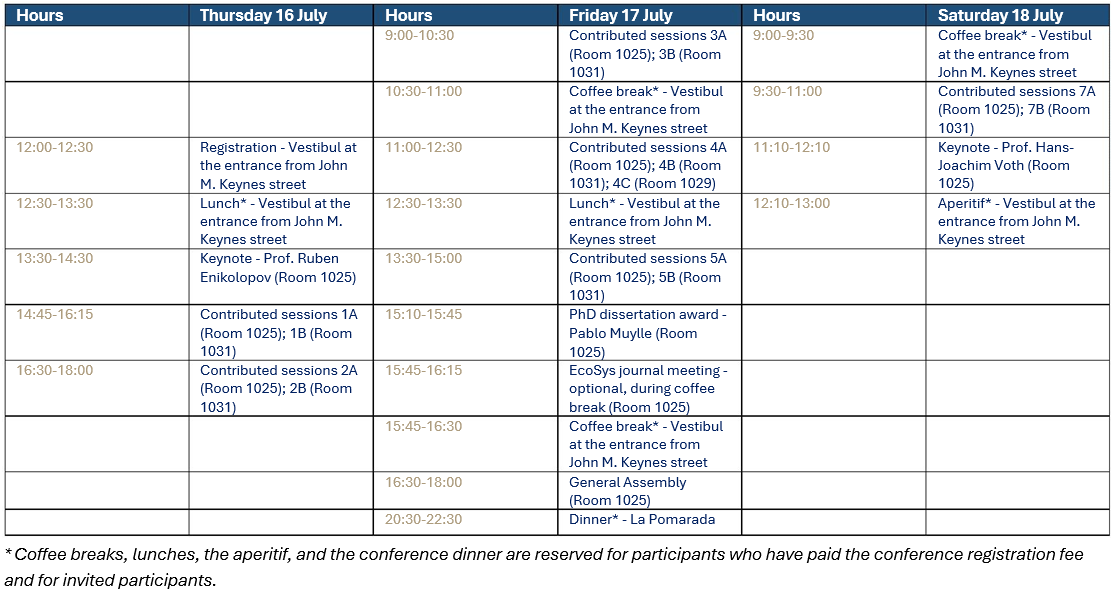
Thursday 16 July |
|
12:00-12:30 Registration |
|
12:30-13:30 Lunch |
13:30-14:30 Keynote lecture (Room 1025)
Keynote – Prof. Ruben Enikolopov, ICREA-UPF and BSE. Socializing Alone: How Online Homophily Has Undermined Social
Cohesion in the US
|
14:45-16:15 Contributed sessions |
|
1A. Political economy and conflict (Room 1025) |
|
Chair: Carlos Suarez |
|
Anna Nicińska, University of Warsaw, Olga Popova (IOS, IZA), Joan Costa-Font (LSE, IZA). Networks of Privilege? Wealth and Human Capital Effects of Communist Party Connections |
|
Yegor Albitskii, Freie Universität Berlin. The Effect of Secondary Schools Expansion on Revolutionary Voting |
|
Sinara Gharibyan, IOS Regensburg, Christian Ochsner (CERGE-EI), Monika Köppl-Turyna (EcoAustria). Gendered Voting After War: Casualties, Victimisation and Nation Building |
|
Carlos Suarez, Universitat Rovira i Virgili, Germà Bel (Universitat de Barcelona), Paula Bel-Piñana (Universitat Abad Oliva). Concrete Threats, Abstract Risks: Field Evidence of Infrastructure Use Under Persistent Political Violence |
|
1B. Labour markets and inequality (Room 1031) |
|
Chair: Norberto Pignatti |
|
Jaan Masso, University of Tartu, Matti Sarvimäki (Aalto University), Aapo Stenhammar (University of Bonn). Opening Borders: Self-Selection and Labor Market Returns to Migration During the EU Enlargement Maciej Albinowski, Institute for Structural Research (IBS). What Explains the East-West Gap in Part-Time Employment in Europe? |
|
Gorana Krstić, University of Belgrade, Faculty of Economics and Business, Aleksandra Anić (University of Belgrade, Faculty of Economics and Business), Barry Reilly (University of Sussex). Female Occupational Intensity and Wages Across the Unconditional Wage Distribution in Serbia |
|
Norberto Pignatti, International School of Economics at Tbilisi State University (ISET), Thomas Dohmen (Bonn University, University of Maastricht and IZA), Melanie Khamis (Wesleyan University and IZA), Hartmut Lehmann (Department of Economics, New Uzbekistan University, University of Bologna and IZA). Risk Attitudes and Informal Employment in Ukraine |
|
16:30-18:00 Contributed sessions |
|
2A. Assortative mating and mobility (Room 1025) |
|
Chair: Anna Naszodi |
|
Ana Kujundzic, International Demographic Inequality Lab (IDIL). Educational Assortative Mating and Household Income Inequality: Evidence from Brazil, Indonesia, Mexico, and South Africa Ricard Grebol Jiménez, Uppsala University, Margarita Machelett (Banco de España), Jan Stuhler (UC3M), Ernesto Villanueva (Banco de España). Assortative Mating, Inequality, and Rising Educational Mobility in Spain Yuki Takahashi, Tilburg University, Chihiro Inoue (Kobe University), Asumi Saito (North Carolina State University). Does the Gender Ratio at Colleges Affect High School Students’ College Choices? |
|
Anna Naszodi, International Demographic Inequality Lab (IDIL). Using the Stylized U-shaped Trend as an Empirical Selection Criterion for Homophily Measures |
|
2B. Macroeconomic and policy shocks (Room 1031) |
|
Chair: Jürgen Jerger |
|
Jovana Mileusnic, University of Belgrade, Faculty of Economics and Business, Zorica Mladenovic (University of Belgrade). The Impact of Nominal and Real uncertainty on Macroeconomic Variables: Empirical Evidence from Serbia |
|
Olga Popova, Leibniz Institute for East and Southeast European Studies (IOS), Regensburg, Bakhrom Mirkasimov (WIUT), Vladimir Otrachshenko (National Bank of Slovakia), Nargiza Jurakulova (WIUT), Nargiza Alimukhamedova (WIUT). Do Informal Institutions Smooth Well-Being During Economic Hardship? The Case of the Uzbek Gap |
|
Svatopluk Kapounek, Mendel University in Brno, Evžen Kočenda (Charles University), Martin Stachoň (Mendel University in Brno). Peer Effects in Bank Lending: Evidence from Bank–Firm and Bank–Bank Channels |
|
Jürgen Jerger, University of Regensburg. The Digital Euro – Conceptual Issues and Implications Beyond the Euro Area |
|
Friday 17 July |
|
9:00-10:30 Contributed sessions |
|
3A. Sanctions and trade (Room 1025) |
|
Chair: Iikka Korhonen |
|
Dai Yamawaki, Hokkaido University. Economic Sanctions and Environmental Investment: Evidence from Russian Listed Firms Alexander Plekhanov, European Bank for Reconstruction and Development, Beata Javorcik (University of Oxford, EBRD and CEPR), Wenzhang Zhang (University of Oxford). Brand New World: The Impact of Trade Sanctions on Firms’ Trademark Registrations |
|
Csaba Weiner, ELTE Centre for Economic and Regional Studies, Agnieszka Głodowska (Krakow University of Economics, Poland), Agnieszka Hajdukiewicz (Krakow University of Economics, Poland), Bożena Pera (Krakow University of Economics, Poland). EU Sanctions and Visegrad Countries’ Trade with Russia: Evidence from Two Sanctions Episodes Iikka Korhonen, Bank of Finland, Heli Simola (Bank of Finland). From Sanctions to Price Surges: The Dynamics of Russia’s Import Prices |
|
3B. Monetary policy and financial shocks (Room 1031) |
|
Chair: Jan-Egbert Sturm |
|
Alexandra Bogner, University of Regensburg. How do Financial Markets React to Central Bank Communication: A Text Analysis of ECB Press Statements Shigeki Ono, Asahikawa City University. U.S. Monetary Policy Shocks and BRICS Financial Markets Michael Neugart, Technical University of Darmstadt, Jens J. Krüger (Technical University of Darmstadt). Two Crises, Split Reactions: NATO’s Military Spending Dynamics |
|
Jan-Egbert Sturm, KOF, ETH Zurich, Jakob de Haan (University of Groningen), Rasmus Wiese (University of Groningen). Structural Reforms and the Labour Income Share: Opposing Effects of Financial Sector and Real Economy Reforms |
|
10:30-11:00 Coffee break |
|
11:00-12:30 Contributed sessions |
|
4A. Green industrial policy (Room 1025) |
|
Chair: Yumiko Nakahara |
|
Andrea Éltető, Institute of World Economics, CERS. Green or Autonomous? The Challenges and Contradictions of EU Industrial Policy in the Member States Attila Havas, Centre for Economic and Regional Studies, Totti Könnölä (Insight Foresight Institute), Matthias K. Weber (AIT Austrian Institute of Technology). Navigating the Security-Sustainability-Innovation Nexus: First Results of a Multi-Level, Multi-Domain Foresight Process |
|
Magdolna Sass, Institute of World Economics, CERS and University of Szeged, Andrea Éltető (Institute of World Economics, CERS). Green Transition or Green Dependency? Multinational Co-Location, EV Batteries and Developmental Trade-offs in Hungary Yumiko Nakahara, Kyushu Sangyo University. Comparative Analysis of TSMC’s Greenfield Subsidiaries in Japan and Germany: A South–North FDI Perspective |
|
4B. Climate and infrastructure (Room 1031) |
|
Chair: Hamza Mohammad Syed |
|
Marek Folprecht, Prague University of Economics and Business. Flood Damage Simulator A Tool for Assessing Property Risk |
|
Vladimir Otrachshenko, National Bank of Slovakia, Roman Vasil’ (National Bank of Slovakia and Charles University). Temperature and Firms’ Performance: Outcomes, Mechanisms, and Coping Strategies Tereza Varejkova, American University. Large-Scale Irrigation and Water Use Inequality in South Africa Hamza Mohammad Syed, London School of Economics and Political Science. Power to progress: Electricity Supply, Inequality and Development in Rural India |
|
4C. Historical political economy and political change (Room 1029) |
|
Chair: Won Yong Kim |
|
Julia Zimmermann, Universidad Carlos III de Madrid, Gerda Asmus-Bluhm (University of Hohenheim), Andrei Markevich (University of Helsinki), Marvin Suesse (Trinity College Dublin). Institutional Reform and Revolutionary Mobilization: Evidence from Late Imperial Russia Aleksandr V. Gevorkyan, St. John’s University. Capitalism in the Caucasus: Comparative Analysis of Structural Macroeconomic Development in Armenia and Georgia |
|
Won Yong Kim, Augsburg University. Monitoring Costs and Agency Problems in Non-Market Economies: Evidence from Nighttime Light Data of North Korean State-Owned Enterprises |
|
12:30-13:30 Lunch |
|
13:30-15:00 Contributed sessions |
|
5A. AI, technology and productivity (Room 1025) |
|
Chair: Antonio León |
|
Germana Giombini, University of Urbino Carlo Bo, Andrea Bacchiocchi (University of Urbino), Ludovica Segneri (University of Urbino), Francesco Venturini (University of Urbino). Financial Risk and Technology Shifting: Firm-Level Evidence from the Rise of AI |
|
Francesco Venturini, University of Urbino, Julia Jablonska (1SGH Warsaw School of Economics), Aleksandra Parteka (Gdansk University of Technology). Artificial Intelligence and Income Growth Divide: Evidence from Global Regional Data Vahagn Jerbashian, University of Barcelona, Montserrat Vilalta-Bufi (University of Barcelona). Modern Technology Use at Work |
|
Antonio León, Bocconi University. Formal Jobs and the Cultural Right |
|
5B. Institutions, convergence and migration (Room 1031) |
|
Chair: Salavat Abylkalikov |
|
Domagoj Račić, University of Zagreb, Valentina Vučković (University of Zagreb), Ružica Šimić Banović (University of Zagreb). Towards the Political Capitalism Index: Methodology, Preliminary Findings and Implications for CEE Countries Beata Farkas, University of Szeged. Dynamism in Integration and Intergovernmental Cooperation ‒ The “liberum veto” Moment of the European Union Timothy Yaw Acheampong, University of Szeged. Convergence Without Inclusion? The Speed of Income and Inequality Convergence in CEE vs. the EU |
|
Salavat Abylkalikov, University of Regensburg. The Great Uncoupling: Economic Implications of the Russo-Central Asian Migration Rupture |
|
15:10-15:45 PhD dissertation award: Pablo Muylle (Room 1025) |
|
15:45-16:30 Coffee break |
|
15:45-16:15 EcoSys journal meeting – during coffee break (Room 1025) 16:30-18:00 General Assembly (Room 1025) |
|
20:30-22:30 Dinner (La Pomarada; for registered and invited participants) |
|
Saturday 18 July |
|
9:00-9:30 Coffee break |
|
9: 30-11:00 Contributed sessions |
|
7A. Markets and state capacity (Room 1025) |
|
Chair: Jean-Baptiste Marigo |
|
Justin Jihao HONG, Hong Kong University of Science and Technology, Qingyuan Chai (NYU Shanghai). Demographics and Elite Persistence: Evidence from China’s Fertility Restrictions |
|
Luca Scotti, Ca’ Foscari University of Venice. Market Power and Network Structure |
|
Jean-Baptiste Marigo, University of Strasbourg, Axelle Heyert (University of Quebec in Montreal), Laurent Weill (University of Strasbourg). When the Prince Is Not Charming: How Gender Bias in Folklore Shapes Intimate Partner Violence |
|
7B. Media, security and regulation (Room 1031) |
|
Chair: Liis Roosaar |
|
Alina Verashchagina, G. d’Annunzio University of Chieti-Pescara, Debora Di Gioacchino (Sapienza University of Rome). Media Exposure, Public Attitudes Toward Immigration, and Policy Support |
|
Maria Siranova, Slovak Academy of Sciences, Martin Hodula (Czech National Bank), Ondrej Zavacky (Technical University in Ostrava). Geopolitical Risks and Capital Flows: Intensive and Extensive Margin |
|
Fabrizio Pompei, University of Perugia, Piotr Lewandoski (Institute for Structural Research, Poland), Wojciech Szymczak (Institute for Structural Research, Poland). Labour and Product Market Regulation and Vulnerability Liis Roosaar, University of Tartu, Pille Mõtsmees (University of Tartu). Testing the U-shape of Occupational Mobility in Estonia |
|
11:10-12:10 Keynote lecture (Room 1025) |
|
Keynote – Prof. Hans-Joachim Voth, University of Zurich. Social Dynamics and Political Extremism: Evidence from the Rise of the Nazi Party |
|
12:10-13:00 Aperitif |